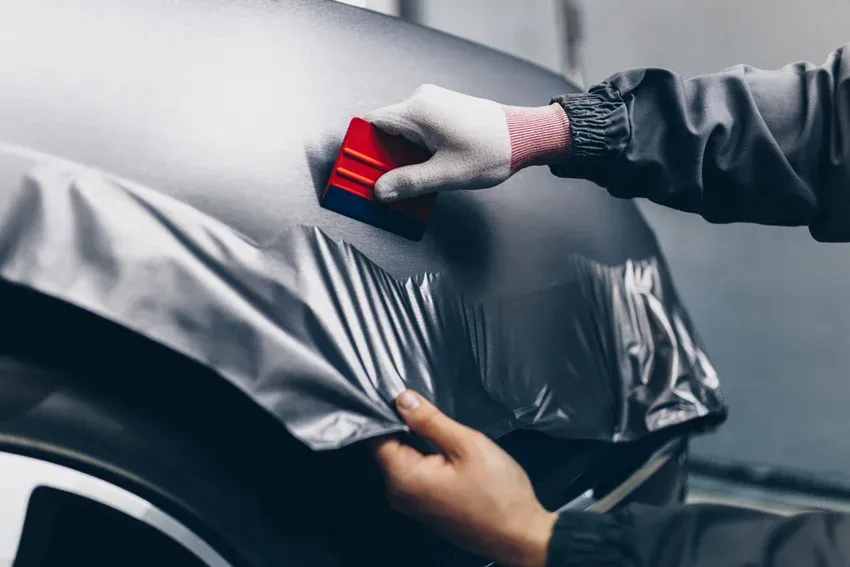
A car wrap is one of the more expensive vehicle modifications you can do, but it’s also one of the most reversible. Unlike a custom paint job, a vinyl wrap can be removed — theoretically returning the vehicle to factory appearance. The "theoretically" exists because the quality of the result depends on the installer, the film quality, and the condition of the underlying paint when the wrap was applied.
This guide covers realistic costs, how to evaluate wrap quality and installers, and the honest answer on resale value. This is part of the Total Ownership Guide.
Full Wrap vs. Partial Wrap vs. Accents
Full wrap: Covers the entire exterior of the vehicle — all painted body panels, including roof, hood, trunk, fenders, doors, and bumpers. The windshield and windows are not wrapped. The most dramatic transformation and the most labor-intensive installation.
Partial wrap: Covers specific sections — typically the hood and roof, a racing stripe pattern, or the lower sections of the body. Used for color accents or to wrap only the areas with significant paint fade or damage.
Accent wraps: Specific panels, mirrors, trim, or interior elements. Door handles, mirror caps, pillar trim, roof. Entry-level modification cost with significant visual impact.
Paint protection film (PPF): A transparent or barely-visible film applied primarily to high-impact areas (hood, front bumper, rocker panels) to protect paint from chips and scratches. Related but distinct from decorative vinyl — different product, different purpose, different cost.
Car Wrap Cost: Professional Installation
Full wrap cost range: $2,000–$6,000 for most passenger cars and trucks. The range reflects:
- Vehicle size and complexity (a sports car with curved surfaces is more labor-intensive than a sedan)
- Film brand and quality
- Installer experience and market
- Color/finish (matte and specialty finishes cost more than standard gloss)
Cost benchmarks by vehicle type:
- Compact car (Civic, Corolla): $2,000–$3,500
- Mid-size sedan (Camry, Accord): $2,500–$4,000
- Full-size truck or SUV: $3,500–$6,000
- Exotic or high-complexity vehicle: $5,000–$10,000+
Partial wrap: $500–$2,500 depending on the scope and panels covered. A hood-and-roof combination on a sedan runs $600–$1,200 at a quality installer.
Accent wraps: $100–$500 for mirror caps, trim pieces, or small panels.
Film Brands and Quality Tiers
The vinyl wrap market has three quality tiers that significantly affect longevity and finish quality.
Entry-level / budget: 3–5 year lifespan, limited color selection, more prone to lifting at edges and seams, harder to work with for installers. Brands: Avery SW900 budget grades, generic import films.
Mid-tier: 5–7 year lifespan, wider color selection, better conformability on curves. Brands: Avery Dennison SW900, 3M 1080.
Premium: 7–10+ year lifespan with a manufacturer warranty, best conformability, widest range of finishes (matte, satin, chrome, color-shift). Brands: XPEL Wrap, Avery Supreme Wrapping Film, 3M 2080, Llumar.
The installer matters as much as the film. A premium film installed poorly — with lifting edges, visible seams, poor heat forming on curves — produces worse results than a mid-tier film installed by an experienced installer. Ask for a portfolio of completed work before committing to any installer.
Wrap vs. Paint: The Honest Comparison
Cost: A professional quality paint job ($3,000–$8,000 for a respectable respray) overlaps with the full wrap cost range. Cheap paint jobs ($500–$1,500) are cheaper than any full wrap but produce a result that often looks worse than the original paint they are covering.
Reversibility: Vinyl wrap can be removed without damage to the underlying paint if the paint was in good condition and properly prepped when the wrap was applied. Paint is permanent. This is the wrap's primary advantage for owners who may want to sell the vehicle or return it to stock.
Durability: Quality paint is more durable against scratches, chips, and long-term UV degradation. A wrap surface scratches more easily than a hardened automotive clear coat.
Finish: Modern vinyl has reached a point where high-quality finishes — particularly matte and satin — are difficult or impossible to replicate with paint at the same cost. Matte paint is expensive, delicate, and nearly impossible to repair spot-by-spot. Matte vinyl is achievable at a fraction of the cost and repairable in sections.
PPF advantage: A wrap over a base of paint protection film on high-impact areas gives the best of both — paint protection on the most vulnerable surfaces, wrap appearance on the rest. Many enthusiasts do PPF on hood, bumper, and mirrors, with wrap over the remaining body.
Does a Wrap Protect the Paint Underneath?
A wrap does provide some physical protection — minor abrasions, light contact, dust and grit — but it is not a substitute for paint protection film. Wraps are not designed to absorb rock chips the way PPF is. The underlying paint is protected from UV and oxidation, which helps preserve its condition.
The critical requirement: The paint under a wrap must be in good condition when the wrap is applied. Wrapping over peeling clear coat, rust bubbles, or flaking paint traps moisture and accelerates the existing damage. The wrap will also look poor over damaged paint — every surface imperfection shows through.
When removing a wrap: If the underlying paint had any adhesion issues, chips, or defects before wrapping, removal can pull paint off. This is why installers inspect paint condition before wrapping and why wrapping a vehicle with failing paint carries risk.
DIY Car Wrapping
Entry cost: $200–$600 for enough film to cover a full car (mid-tier film). Tools: heat gun, squeegee set, felt-edge squeegee, slip solution, and knifeless tape for trimming.
Skill ceiling: DIY wrapping is achievable on flat and moderately curved panels. Deeply contoured areas — bumpers, mirrors, door handles, A-pillars — require significant heat forming skill and practice. Bubbles, lifting edges, and visible panel seams are common first-attempt results.
Practical approach: Many DIYers wrap individual panels (roof, hood) rather than attempting a full car. Smaller panel projects build skill and produce usable results without the waste of a failed full-car attempt.
Film waste: Professional installers waste 15–30% of film on a full car. First-time DIYers waste significantly more. Buy more film than theoretical coverage suggests.
Wrap and Resale Value
A wrap does not inherently add resale value. Many buyers prefer factory paint color and will discount a wrapped vehicle — they cannot verify the paint condition underneath without removing the wrap.
Factors that affect wrap impact on resale:
- Color choice: neutral colors (white, black, grey, silver) have broader buyer appeal; unusual or polarizing colors narrow the buyer pool
- Wrap condition: a well-maintained, undamaged wrap that can be cleanly removed is neutral to mildly positive; a bubbling, lifting, sun-bleached wrap is a negative
- Original paint condition: if the wrap was protecting excellent original paint, removing it before sale demonstrates this and can be a positive
If you plan to sell within 2–3 years, factor in the cost of professional wrap removal ($500–$1,500) or price the vehicle with the wrap on and expect some buyers to negotiate accordingly. See the selling guide for how modifications affect the sale process.
Frequently Asked Questions
*All ranges and costs are estimates and may vary.