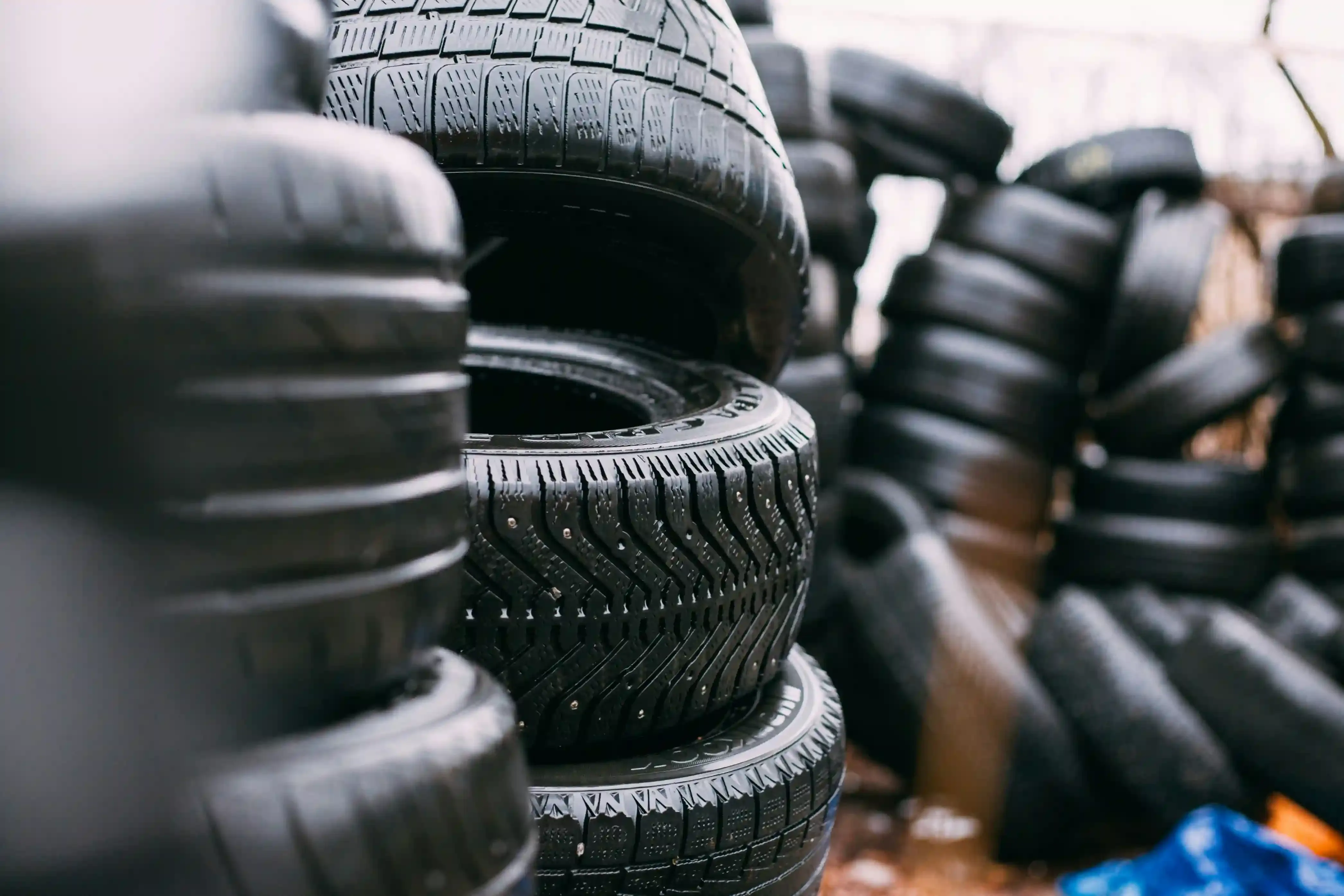
What Tires Tell You Beyond Tread Depth
Direct answer: Tires communicate four distinct categories of information to a trained inspector: remaining service life (tread depth), chronological age (date code), vehicle alignment and suspension health (wear pattern), and rough validation of odometer accuracy (wear amount relative to listed mileage). A buyer who checks only tread depth is reading one chapter of a four-chapter story.
Most buyers check tread depth and stop there. This guide covers all four.
Check 1: Tread Depth — The Penny and Quarter Tests
Direct answer: Check tire tread depth by inserting a quarter into the tread groove with Washington's head pointing down. If the top of Washington's head is fully visible above the tread, the tire has less than 4/32" of tread and should be replaced within the year. Insert a penny for the legal minimum check — if Lincoln's head is completely visible, the tire is at or below the 2/32" legal minimum and must be replaced immediately.
Why 2/32" Is Not the Real Threshold
The legal minimum tread depth in most states is 2/32". This is not a safety threshold — it is a legal one. At 2/32" of tread, wet weather stopping distances are dramatically increased compared to a tire with 4/32" of tread. In emergency braking on wet pavement, the difference between 2/32" and 4/32" can be 20–30 additional feet of stopping distance — the length of two car lengths.
The practical threshold for tire replacement is 4/32" — the quarter test threshold. Tires below 4/32" are not unsafe in dry conditions, but they provide significantly reduced performance in rain, and in snow or ice they are effectively useless.
How to Perform the Tests
The Quarter Test (4/32" threshold): Insert a quarter into the main tread groove with George Washington's head pointing toward the tire. If the top of Washington's head disappears into the tread, the tire has more than 4/32" remaining. If Washington's head is fully visible above the tread surface, the tire is approaching end of life and replacement should be factored into the purchase price.
The Penny Test (2/32" legal minimum): Insert a penny into the main tread groove with Abraham Lincoln's head pointing toward the tire. If any part of Lincoln's head is obscured by the tread, the tire is above the legal minimum. If Lincoln's head is completely visible above the tread, the tire is at or below 2/32" and is legally worn out in most states.
Test multiple groove locations: Insert the coin into the center groove and both outer grooves of each tire. Tread depth is not always uniform across the width of the tire — uneven wear means different grooves show different depths, and the shallowest point is what matters.
Check 2: Tire Age — The Date Code
Direct answer: Find the DOT number on the sidewall of each tire and read the last four digits as the manufacture date — the first two digits are the week of manufacture and the last two are the year. Tires older than six years should be replaced regardless of tread depth, because rubber oxidizes internally over time and becomes brittle, significantly increasing the risk of a sudden blowout even on a tire with visually acceptable tread.
How to Read the DOT Date Code
Every tire sold in the United States carries a DOT (Department of Transportation) code molded into the sidewall. The full DOT number is a string of letters and numbers — the manufacture date is encoded in the last four digits only.
Format: WWYY (Week Week Year Year)
Examples:
- 2419 = 24th week of 2019 = manufactured in June 2019
- 0322 = 3rd week of 2022 = manufactured in January 2022
- 4817 = 48th week of 2017 = manufactured in November 2017
The DOT code may be molded on the inboard side of the tire — the side facing the vehicle — rather than the outboard side visible from outside the car. If you cannot find it on the visible sidewall, crouch down and look at the inner sidewall with a flashlight.
Why Six Years Is the Threshold
Rubber is a polymer that degrades through a process called oxidation — exposure to oxygen, ozone, UV light, heat cycling, and load stress causes the polymer chains to break down and the rubber to harden and become brittle. This process occurs at the molecular level and produces no visible surface indication until the degradation is advanced.
A tire that is seven years old with 8/32" of tread remaining — visually appearing to have significant life left — may have internal rubber that is brittle enough to fail suddenly under highway-speed stress. The tread does not wear off; the tire fails structurally. This is why tires have an age limit independent of tread depth.
Most tire manufacturers, including Michelin, Bridgestone, and Continental, recommend replacing tires at six years regardless of tread depth. The National Highway Traffic Safety Administration recommends replacement by ten years as an absolute maximum — but six years is the practical threshold for predictable safe performance.
Check all four tires plus the spare. Mismatched date codes — three tires from 2021 and one from 2017 — indicate one tire was replaced independently, which is normal. All four tires older than six years means the vehicle has been running on expired rubber, which is both a safety issue and a negotiating point.

Car Negotiation Scripts: Word-for-Word Lines That Could Save You Money
Car negotiation scripts for real scenarios. Learn exactly what to say, using facts like VIN reports and inspections to keep leverage on your side.
Check 3: Wear Patterns — What They Diagnose
Direct answer: Examine the wear pattern across the full width of each tire. Even wear from edge to edge indicates correct alignment and inflation history. Uneven wear — concentrated on the inner edge, outer edge, or center — diagnoses specific mechanical conditions: alignment problems, chronic underinflation or overinflation, or suspension component wear. Uneven wear on a used car means either a repair was deferred or the car was driven hard in conditions that caused accelerated wear.
This is where tires become a diagnostic tool, not just a safety checklist item.
Center Wear: Chronic Overinflation
A tire worn primarily across the center tread with relatively fresher tread on both outer edges has been chronically overinflated. When a tire carries more air pressure than specified, it bulges slightly at the center, causing the center to bear the vehicle's weight disproportionately.
Center wear alone is not a serious mechanical concern — it indicates maintenance neglect (running overinflated tires), not a mechanical fault. Replace the tires at the correct pressure and the wear pattern normalizes.
Edge Wear: Chronic Underinflation
A tire worn on both outer edges with fresher tread in the center has been chronically underinflated. When a tire carries less air than specified, it flattens slightly under load, causing the outer edges to contact the road more than the center.
Like center wear, edge wear alone indicates maintenance neglect. It does not indicate a mechanical fault. However, chronically underinflated tires generate excess heat and can damage the tire's internal structure — a used car with severe edge wear on all four tires may have tires with internal heat damage even if tread depth appears acceptable.
One-Sided Wear: Alignment and Suspension Problems
Inner edge wear — tread worn significantly on the inside edge of the tire but not the outside — indicates excessive negative camber. Camber is the tilt of the wheel relative to vertical. Excessive negative camber means the top of the wheel tilts inward too far, causing the inner edge to bear disproportionate load.
Causes of excessive negative camber: a worn or damaged strut, a bent control arm, a failed ball joint, or a suspension geometry issue from prior collision damage that was never properly realigned. These are not tire problems — they are suspension problems that destroy tires as a symptom.
Outer edge wear — tread worn on the outside edge — indicates excessive positive camber or aggressive cornering behavior. Less common than inner edge wear, and more often indicates the car was driven hard in performance applications.
Feathering — a sawtooth wear pattern visible when you run your hand across the tread blocks — indicates toe misalignment. Toe refers to whether the front of the tires point slightly inward (toe-in) or outward (toe-out) relative to the direction of travel. Toe misalignment causes the tire to scrub sideways microscopically with every rotation. An alignment corrects toe — but existing feathered tires are consumed and must be replaced.
Cupping or Scalloping: Shock Absorber Failure
Cupping — a wave-like or scalloped wear pattern around the circumference of the tire, as if small scoops were taken out of the tread at regular intervals — indicates failed shock absorbers or struts. When a shock absorber loses damping ability, the wheel bounces rhythmically over road irregularities instead of maintaining consistent contact. Each bounce removes a small amount of tread at the contact point, producing the scalloped pattern.
Shock absorber and strut replacement costs $400–$1,200 per axle depending on the vehicle. A car with cupped tires needs new shocks, new tires, and a post-repair alignment.
Check 4: Odometer Consistency
Direct answer: Compare the visible tire wear amount against the odometer reading and the tire's manufacture date to assess whether the mileage is plausible. A car listed at 35,000 miles on tires manufactured in 2019 where the tread is nearly worn out has driven significantly more miles than the odometer shows, or has been driven in conditions that accelerate tire wear abnormally.
The Mileage Math
The average tire lasts 40,000–60,000 miles under normal driving conditions. A tire manufactured in 2020 on a car listed at 45,000 miles in 2025 should have substantial tread remaining — 4/32" to 6/32" depending on the tire's original tread depth. If those same tires are nearly worn out, the math does not work. Either the odometer has been rolled back, the car was driven in conditions that destroy tires (aggressive driving, very poor roads, sustained high speeds), or the tires were replaced and the current set has accumulated the listed mileage plus additional mileage from the previous set.
This is not a definitive odometer fraud indicator on its own — it is a flag that warrants cross-referencing with the mileage records in the vehicle history report. If the report shows 90,000 miles in 2022 and the odometer reads 65,000 miles in 2025, the tires make sense. The odometer does not.
The Spare Tire
Do not forget the spare. Check three things:
Presence: Confirm a spare tire exists and is secured in its designated location — trunk well, under the bed of a truck, or mounted externally. Some sellers remove spares.
Inflation: Press the sidewall — a properly inflated spare is firm. A flat spare is useless in a roadside emergency and indicates the car has not been maintained.
Type and condition: A full-size spare matching the vehicle's other tires is the best case. A compact spare ("donut") is normal on many vehicles but is limited to 50mph and 50–70 miles of use. Check the tread depth and date code on the spare using the same tests above — a spare on an expired date code is a spare that should not be trusted in an emergency.
Turning Tire Findings Into Negotiating Leverage
Tire findings are among the most straightforward negotiating points in a used car purchase because they are quantifiable with specific dollar amounts.
The framework:
- Document every tire finding during inspection — date code, tread depth result, and any wear pattern noted on each tire
- Get a tire quote from a local tire shop before negotiating — a specific dollar figure for the replacement cost of the tires that failed your inspection
- Present the findings as factual data: "Three of the four tires have date codes from 2017 — they are eight years old and need immediate replacement. A set of four replacement tires for this vehicle is $740 installed at [shop name]. I am adjusting my offer accordingly."
This approach is not aggressive — it is precise. The seller cannot argue with a date code or a tire shop quote. They can either adjust the price, agree to replace the tires before closing, or decline. All three outcomes are acceptable. None of them involves guessing.